Three weapons survive in modern competitive fencing: foil, épée, and sabre. The
spadroon and the heavy
cavalry-style sabre, both of which saw widespread competitive use in the 19th century, fell into disfavour in the early 20th century with the rising popularity of the lighter and faster weapon used today. The
singlestick was featured in the 1904 Olympic Games, but it was already declining in popularity at that time.
Bayonet fencing experienced a somewhat slower decline, with competitions organized by some armed forces as late as the 1940s and 1950s.
While the weapons fencers use differ in shape and purpose, their basic construction remains similar across the disciplines. Every weapon has a
blade and a
hilt. The tip of the blade is generally referred to as
the point. The hilt consists of a
guard and a
grip. The guard (also known as the
coquille, the
bell, or the
bellguard) is a metal shell designed to protect the fingers. The grip is the weapon's actual handle. There are a number of commonly used variants. In foil and épée the more traditional French grip is approximately straight and usually terminates with a
pommel (a heavy nut intended to act as a counterweight for the blade and to hold the handle on the weapon). Some modern designs of French grip do not use a heavy pommel nut, in an effort to construct the lightest épée possible.
The Italian grip, which dates from a similar period as the French, has fallen out of general favor. The Italian features a completely straight handle and a crossbar beneath the guard that the fencer can use to manipulate the blade. The crossbar is known for causing injury, as the fencers fingers can become stuck if the blade is turned in a way that was not expected. It is the only ambidextrous fencing grip, and many fencers with arm trouble use it so they can freely switch without having to carry twice as many blades. The Italian is banned in some regions, and is mistakenly believed to be banned in others, necessitating that users often carry explicit rulings to show judges to prove it is allowed.
The straight grips have been entirely replaced in higher level foil fencing, and partially replaced in épée fencing, by a variety of
ergonomic designs, called as a group pistol grips or orthopaedic grips. There are a large variety of designs, the most popular of which are the
Visconti,
Belgian, and
Russian grips, collectively referred to by some as standard grips. Grips produced by
Zivkovic fencing are also popular, and are the most commonly seen 'non-standard' grips.
All of the weapons used for modern competition have electrical wiring which allows them to register a touch on the opponent.
Main article:
Foil (fencing) Short clip of foil fencing

International valid foil target - the torso, and the portion of the bib 1.5-2cm below chin level. Note that the USFA does not use the bib target in the United States.
The
foil is a light and flexible weapon, originally developed in the mid 17th century as a training weapon for the Pariser
small sword, a light one-handed sword designed almost exclusively for thrusting.
In modern competitive fencing, 'electric' weapons are used. These have a
push-button on the point of the blade, which allows hits to be registered by the electronic scoring apparatus. In order to register, the button must be depressed with a force of at least 4.90
newtons (500
grams-force) for at least 15
milliseconds. Foil fencers wear conductive (
lamé) jackets covering their target area, which allow the scoring apparatus to differentiate between on- and off-target hits.
The target area is restricted to the torso, including the front and back. When fencing with electrical equipment, there is an area around each armpit that is not covered by the
lamé, and is thus effectively not legal target as well.
A modification in FIE rules from 1 January 2009 onwards means that the valid target area includes that part of the bib below a straight line drawn between the shoulders; prior to this, the bib of the mask was not a valid target. The wisdom of this rule is currently widely disputed; the prevailing attitude in the US is that the rule will lead to a great increase in equipment failures and costs, while European opinion is that this will help prevent fencers from covering target.
This rule has not been implemented uniformly in all National fencing organizations. European fencing organizations have generally decided on September 1, 2009 as the date for all competitions to use the new rule.
[citation needed]
As of September 1, 2009, the USFA has decided not to implement the bib as target for foil. After reviewing international competitions, it was observed that very few hits were actually scored under the new rules. Given the expense of having to replace equipment, as well as the safety concerns of allowing hits in the region of the throat, the USFA rejected the change. All domestic competitions in the US will not require the bib target; however, international events such as Junior or Senior World Cup Events will require the bib target. There are currently no plans to adopt the rule in the future.
The target must be hit with the tip of the foil; a touch with any other part of the foil has no effect whatsoever and fencing continues uninterrupted. A touch on an off-target area stops the bout but does not score a point. Foil fencing also features rules of
right of way or
priority, which determine which fencer's hit will prevail when both fencers have hit. The basic principle of priority is that the hit of the fencer who begins an offensive action first will prevail over his/her opponent's hit, unless the action of the former fails. A fencer's action fails when it falls short of his/her opponent, when it misses, or when it is
parried. When one fencer's action fails, the other's current or next offensive action gains priority, unless they delay too long (longer than one period of "fencing time", the time taken to perform one action at the current tempo of the exchange), in which case the previously defending fencer loses priority. If priority cannot be determined when both fencers have hit each other, no point is awarded. The original idea behind the rules of foil fencing was to encourage fencers to defend and attack vital areas, and to fight in a methodical way with initiative passing back and forth between the combatants, thus minimizing the risk of a double death.
When an exchange ends in a hit, the referee will call "halt", and fencing will cease. The referee will then analyse the exchange and phrase it in official terminology. The first offensive action is called the attack. All defensive actions successfully deflecting an opponent's blade are called
parries. An offensive action of a parrying fencer directly following the parry is called a
riposte. An offensive action of a fencer, who attacks without first withdrawing the arm directly after being parried, is called a
remise. An offensive action of a fencer from the on-guard position, after being parried and then returning to the on-guard position, is called a reprise. An offensive action of a fencer after his/her opponent has lost the right to riposte via inaction is called a redouble. An offensive action begun by a fencer who is being attacked by his/her opponent is called a counter-attack.
Short clip of épée fencing

Valid target area at Épée (the entire body).
Épée, as the sporting weapon known today, was invented in the second half of the 19th century by a group of French students, who felt that the conventions of foil were too restrictive, and the weapon itself too light; they wanted an experience closer to that of an actual
duel. At the point of its conception, the épée was, essentially, an exact copy of a
small sword but without the needle-sharp point. Instead, the blade terminated in a point d'arrêt, a three-pronged tip which would snag on the clothing without penetrating the flesh.
Like the foil, the épée is a thrusting weapon: to score a valid hit, the fencer must fix the point of his weapon on his opponent's target. However, the target area covers the entire body, and there are no rules regarding who can hit when (unlike in foil and sabre, where there are
priority rules). Because the entire body is target area, when fencing epee electronically, fencers do not wear conductive lamé jackets as they do when fencing foil and sabre. In the event of both fencers making a touch within 40 milliseconds of each other, both are awarded a point (a
double hit), except when the score is equal and the point would mean the win for both, such as in
modern pentathlon's one-hit épée, where neither fencer receives a point. Otherwise, the first to hit always receives the point, regardless of what happened earlier in the phrase. Also épées are the heaviest of the weapons. However, with today's techniques, we see some épée blades as light as 150g. An épée is composed of a blade, a point, a bell guard, and a handle or grip (french or pistol grip).
The 'electric' épée, used in modern competitive fencing, terminates in a push-button, similar to the one on the 'electric' foil. In order for the scoring apparatus to register a hit, it must arrive with a
force of at least 7.35 newtons (750 grams-force) (a higher threshold than the foil's 4.9 newtons), and the push-button must remain fully depressed for 1
millisecond. All hits register as valid, unless they land on a
grounded metal surface, such as a part of the opponent's weapon, in which case they do not register at all. At large events, grounded conductive
pistes are often used in order to prevent the registration of hits against the floor. At smaller events and in club fencing, it is generally the responsibility of the
referee to watch out for floor hits. These often happen by accident, when an épéeist tries to hit the opponent's foot and misses. This results in a pause in the action but no points. However, deliberate hits against the floor are treated as "dishonest fencing," and penalized accordingly.
Épée has less restrictive rules for footwork and physical contact than the other two weapons. In Épée, a corps-à-corps (collision between fencers) is not penalized unless initialized with intent to harm or if it is excessively violent. There are no restrictions on crossing of the feet or use of the flèche attack in épée; if the fencers pass each other, the attacking fencer may score until he passes his opponent. The defending fencer has the right to one continuous riposte, and may still score after the attacker has passed.
The counterattack is very important in épée; direct, unprepared attacks are vulnerable to counterattacks to the hand or arm, or to the body if the attacker is shorter than his opponent. High level épée is often a game of provocation, with each player trying to lure the other into an attack. Distance in épée is even more important than in the conventional weapons.
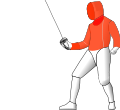
Valid target at
sabre (everything above the waist, excepting the hands and the back of the head).
Sabre is the 'cutting' weapon: points may be scored with edges and surfaces of the blade, as well as the point. Although the current design with a light and flexible blade (marginally stiffer than a foil blade which bends easily up and down while a sabre blade bends easier side to side) appeared around the turn of the 19th and 20th century, similar sporting weapons with more substantial blades had been used throughout the
Victorian era.
There is some debate as to whether the modern fencing sabre is descended from the
cavalry sabres of
Turkic origin, which became popular in
Central and
Western Europe around the time of
Napoleonic Wars, or one of
Europe's indigenous edged duelling weapons, such as the cutting
rapier. In practice, it is likely to be a hybrid of the two. Most of the conventions and vocabulary of modern sabre fencing were developed by late 19th and early 20th century masters from
Italy and
Hungary, perhaps most notable among them being
Italo Santelli (1866–1945).
The sabre target covers everything above the waist, except the hands (wrists are included) and the back of the head. Today, any contact between any part of the blade and any part of the target counts as a valid touch. This was not always the case, and earlier conventions stipulated that a valid touch must be made with the point or either the front or back cutting edge, and that a point attack must not merely graze the target and slip along (pass) the opponent's body. These requirements had to be abandoned, because of technical difficulties, shortly after electronic scoring was introduced into sabre fencing in late 1980s.
Like foil, sabre is subject to
right of way rules, but there are differences in the definition of a correctly executed
attack and
parry. These differences, together with a much greater scoring surface (the whole of the blade, rather than the point alone), make sabre parries more difficult to execute effectively. As a result, sabre tactics rely much more heavily on footwork with blade contact kept to a minimum. Also, play is not halted by an off-target (hands/below the waist) hit in sabre. To prevent both fencers from immediately charging each other at the beginning of fencing action, crossing of the feet is not allowed, which also prohibits use of the
flèche. This results in a penalty against the offending fencer (a warning, followed by awarding a penalty touch if the offense is repeated). A maneuver called a 'Flunge' is sometimes used as a replacement for the outlawed flèche: the fencer leaps at the opponent, being sure to keep his rear foot behind his front as long as possible. Safely landing following this move requires crossing the feet, thus the hit must be scored while airborne. Sabre matches are often decided very quickly compared to the other weapons.


